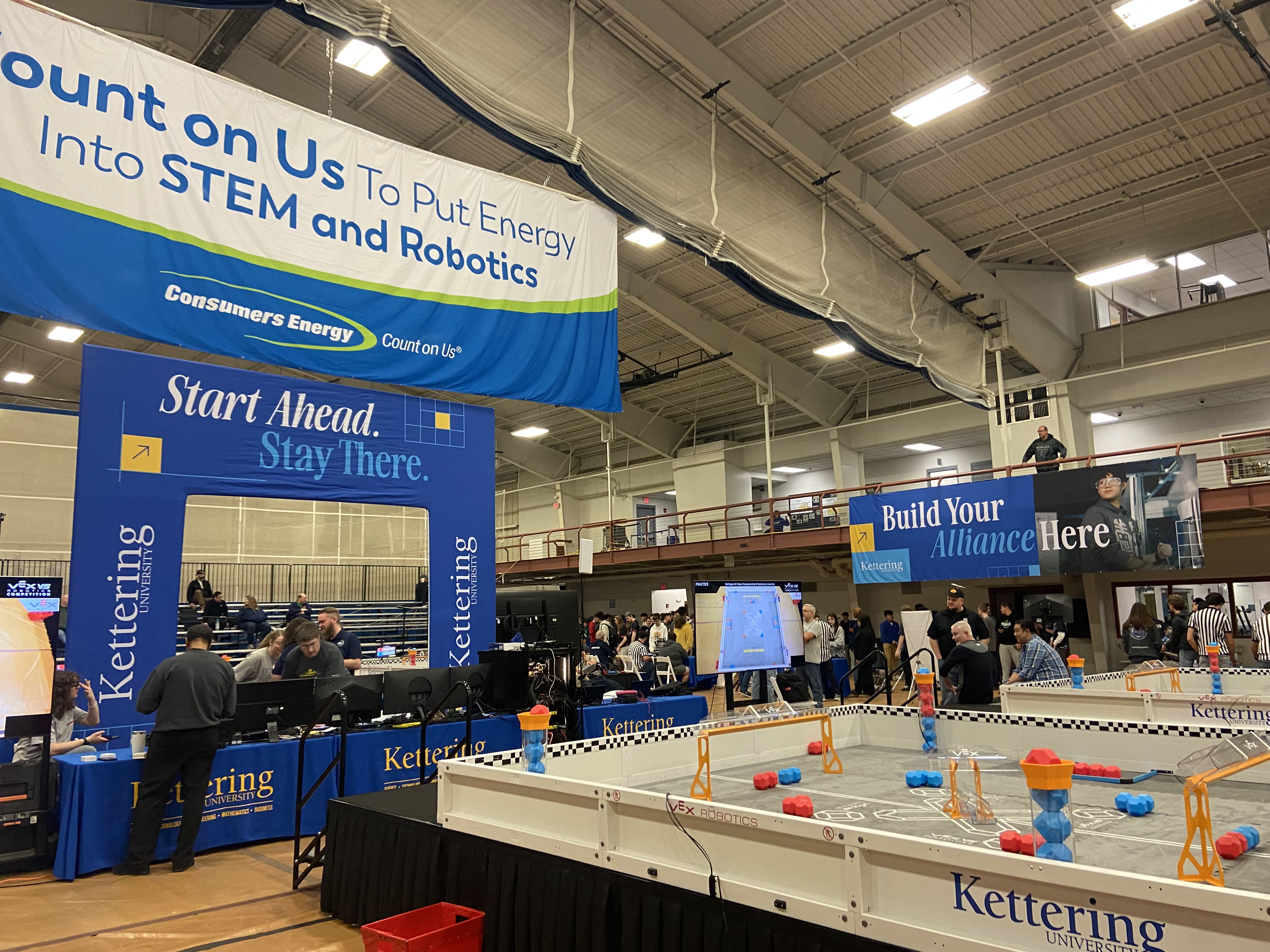
Inside Kettering University’s Connie and Jim John Recreation Center, middle and high school teams from 10 U.S. states and three Canadian provinces moved constantly between competition fields and tables lined with laptops, controllers, batteries, and replacement parts as they reviewed flight footage, checked drone components, and discussed piloting and autonomous flight performance between Matches.
The activity extended well beyond the competition floor. Teams rehearsed piloting sequences in open space near the fields while others reviewed engineering logbooks and prepared for upcoming rounds.
“You could see students constantly adjusting and responding to problems throughout the day,” said Kim Shumaker, Director of Robotics Outreach & Robotics Center at Kettering. “They weren’t standing on the sidelines watching technology work. They were in the process. Testing things, troubleshooting failures, making decisions under time pressure, and immediately trying again when something didn’t go as planned.”
Coaches occasionally stepped in with guidance, but most revisions happened student-to-student in hurried conversations around laptops and performance data minutes before teams returned to the field. A missed gate, rough landing, or unstable autonomous sequence usually triggered another round of testing, debate, and revisions before competition resumed.
"What struck me most was how few students needed to be told what to do," said Matthew Sanker, Director of Sales and Business Development for Firefly Drone Shows. "When something went wrong, they weren't looking around for a coach to fix it. They were figuring out their next move. That kind of ownership is something you can't really teach in a classroom. Watching middle and high schoolers operate that way, with real urgency and real stakes, was genuinely exciting to see."
As competition rounds wrapped up Friday evening, many students traded laptops and telemetry screens for blankets and lawn chairs outside near the Recreation Center, joining families and spectators gathered across the field.
Shortly after sundown, Firefly Drone Shows launched hundreds of synchronized drones into the night sky above the Kettering University GM Mobility Research Center.
Advanced drones, designed and built by Firefly Drone Shows, moved in coordinated formations overhead, transforming technical precision into a large-scale public light performance visible across campus.
The night's drone show scaled up many of the same principles students had tested in competition, with hundreds of drones moving through synchronized formations overhead.
“The challenges students were working through are much more similar to what we do than people might expect,” Sanker said. "Whether you're flying a single drone through competition gates or hundreds of drones through a choreographed series of animations for a live audience, the core challenges are the same: timing, positioning, and making sure every piece of the system is talking to every other piece reliably."
The championship further highlighted Kettering’s growing role in Michigan’s broader robotics and STEM ecosystem through competitions, camps, workshops, and outreach initiatives that connect students with hands-on technical learning earlier in their educational journeys. Support from the GM Community Impact Grant and Magna Grant programs has also helped expand robotics center programming and aerial drone technologies at the university.
By the end of the night, students who had spent the day reviewing flight footage, adjusting code, and troubleshooting drones were gathered outside the Recreation Center, watching hundreds of aircraft move in coordinated formations across the sky above campus.