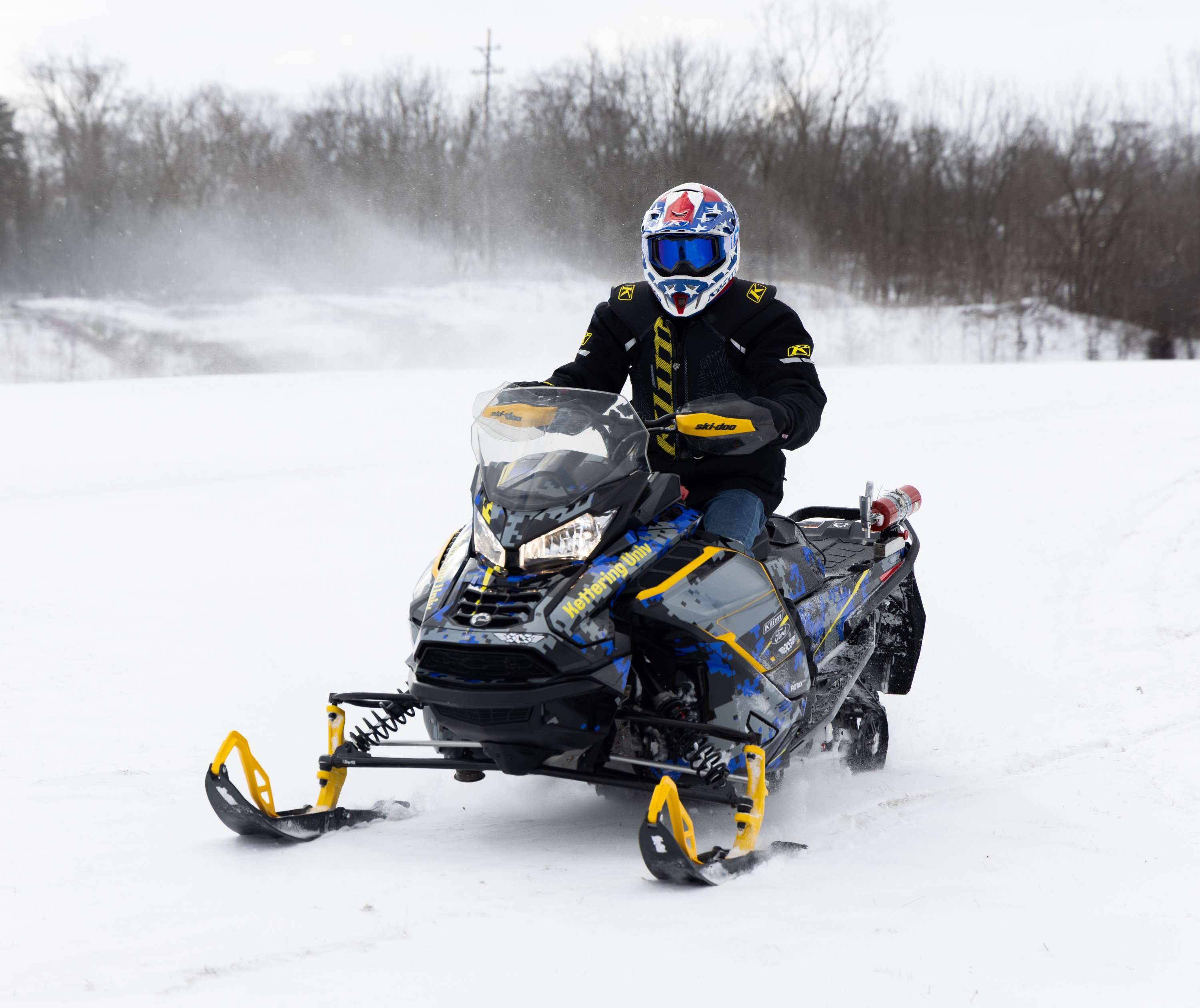
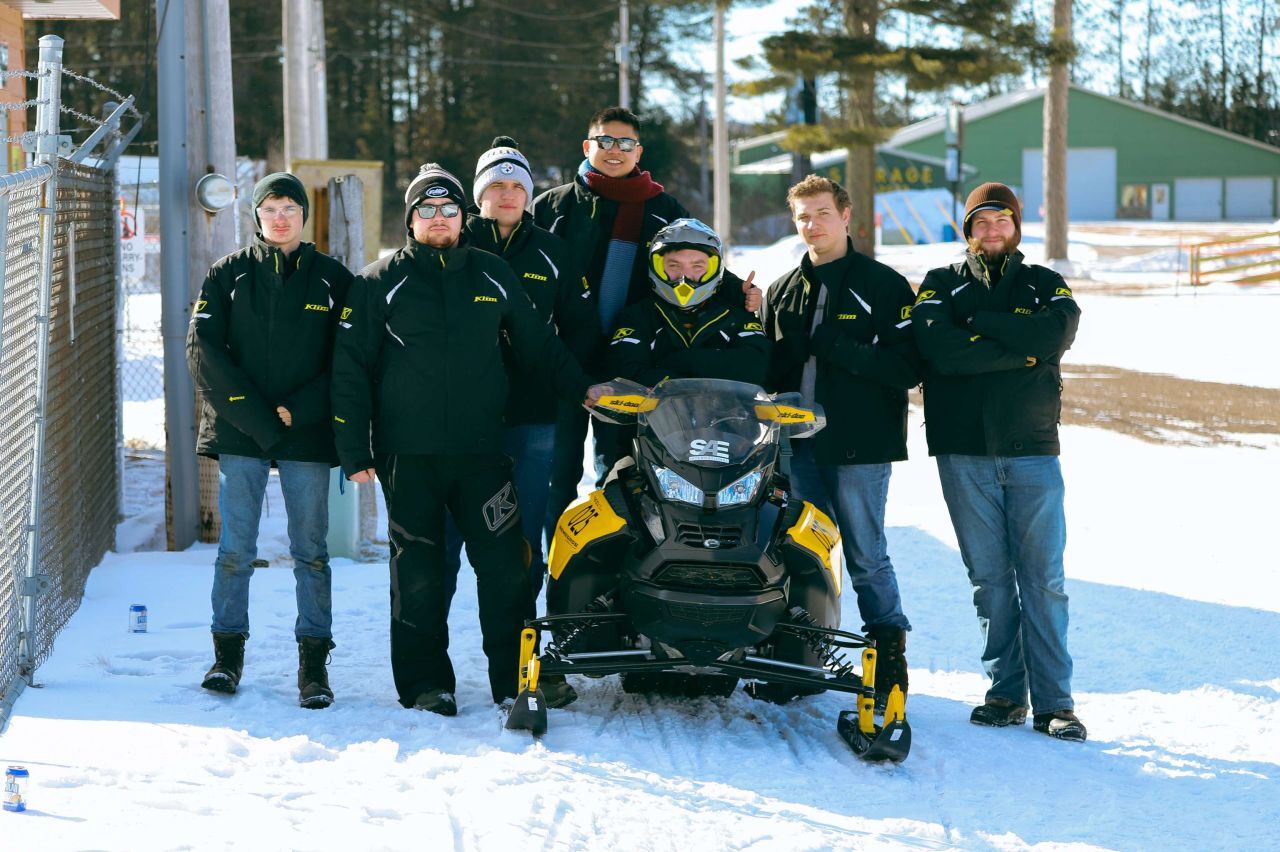
On the snow-packed track at the World Championship Derby Complex in Eagle River, Wisconsin, the machines looked familiar. But beneath their panels and exhaust systems, they were anything but stock.
Each sled on the course represented months of engineering work by university teams determined to improve one of winter’s most recognizable machines. Their challenge: redesign snowmobiles to run cleaner, quieter, and more efficiently without sacrificing performance.
Among those teams was the Kettering University SnowDogs Advanced Snowmobile team, whose engineering work earned fourth place overall among 10 competing universities, along with first place in Fuel Economy and second place in Emissions at the inaugural Advanced Snowmobile Competition, held February 8–12, 2026.
“This competition gives students the opportunity to put their classroom training to use to help solve real-life technical problems facing society," says Dr. Greg Davis, Professor of Mechanical Engineering and Director of the Advanced Engine Research Laboratory at Kettering. "The students' approach to these issues is unique - they think outside the box.”
Engineering a Better Snowmobile
The Advanced Snowmobile competition challenges collegiate engineering teams to rethink how snowmobiles perform in the real world. While snowmobiles have become more advanced over the past several decades, concerns around noise, fuel consumption, and emissions remain central issues for riders, manufacturers, and landowners.
Each participating university begins with a stock snowmobile from one of the three major Snowmobile manufacturers. While teams may use different engine types, such as 4-stroke, 2-stroke, or, new this year, hybrid, all snowmobiles ultimately compete against one another in the same events. This creates a unique engineering challenge, as teams must balance environmental improvements with performance to ensure their machines remain competitive across all aspects of the competition.
For the 2025–2026 season, the Kettering SnowDogs utilized a 2023 Ski-Doo Renegade ACE 900 Turbo Adrenaline as their development platform. Over the course of the year, the team implemented targeted engineering modifications to improve efficiency, reduce emissions, and minimize noise, while meeting stringent Yellowstone Best Available Technology (BAT) requirements.
“The two biggest engineering changes we made were modifying the muffler and installing billet aluminum 9-inch bogey wheels,” said Jason Barksdale, 2025–2026 team lead. “The muffler helped reduce noise while maintaining performance. The upgraded bogey wheels improved durability and overall ride quality.”
One of the team’s primary engineering efforts centered on the exhaust system. Rather than replacing the system entirely, the SnowDogs retained the OEM muffler housing and re-engineered its internal components. This approach preserved factory mounting points and allowed the redesigned system to integrate seamlessly within the snowmobile’s existing architecture.
“Until we get our custom engine tune fully complete, I would say our student-designed muffler is the largest change,” said Joshua Wangelin, CAD/Integration Subsystem Lead. “We managed to get that engine so quiet you can have a normal volume conversation while standing right next to it.”
The result was a fully student-designed muffler system that reduced exhaust noise while maintaining near factory engine performance.
“The goal wasn’t just to make the exhaust quieter,” said Tyler Leschuk, NVH Subsystem Lead for the Kettering SnowDogs Advanced Snowmobile Team. “We also considered psychoacoustic principles so the sound would be less harsh and less fatiguing for riders and the surrounding environment.”
Applying Engineering in Real Conditions
The SnowDogs showcase what students at Kettering University are capable of: transforming a production snowmobile into a refined, competition-ready machine through applied engineering. What begins as a stock vehicle evolves through analysis, design, and testing into a system that is cleaner, quieter, and more efficient, while still meeting the performance demands expected in real-world riding.
For Kettering students, the project requires integrating multiple engineering disciplines, including thermal systems, acoustics, structural design, and vehicle dynamics. Every subsystem must work together as a cohesive whole, where a change in one area—such as exhaust flow or added component weight—can directly influence performance, handling, and durability. This systems-level thinking mirrors the challenges faced in the powersports and automotive industries.
Unlike classroom-based design problems, the team must validate their work under real operating conditions. Long transport distances, cold-weather operation, and sustained run times introduce variables that cannot be fully replicated in a lab environment. Ensuring reliability becomes just as critical as achieving performance targets, as components must withstand vibration, temperature fluctuations, and continuous use without failure.
On-site in Eagle River, final validation takes place on the track. The snowmobile is pushed through extended operation, cornering, acceleration, and varying terrain, allowing the team to evaluate handling stability, chassis response, and overall ride quality in real time.
“Here at Kettering University, we are dedicated to providing engineering students with real-world problem-solving experiences that will make them better engineers for the future,” said Dr. Davis. “The Advanced Snowmobile competition focuses on conducting high-quality research on methods to reduce snowmobile emissions and sound levels without sacrificing performance.”
Competitions like Advanced Snowmobile bridge the gap between theory and practice, requiring students not only to design effective solutions but also to prove them under pressure. The result is an engineering experience that extends beyond calculations and simulations, preparing students to develop systems that perform reliably in the real world.