The sound of a race car engine firing up isn’t so different from the roar of a packed arena — at least not to Chris Ordoobadi.
“I’ve always had two passions — hockey and racing,” he says. “In the first half of my career, I gave everything to hockey. Now, I’m back in school so I can pursue my other passion.”
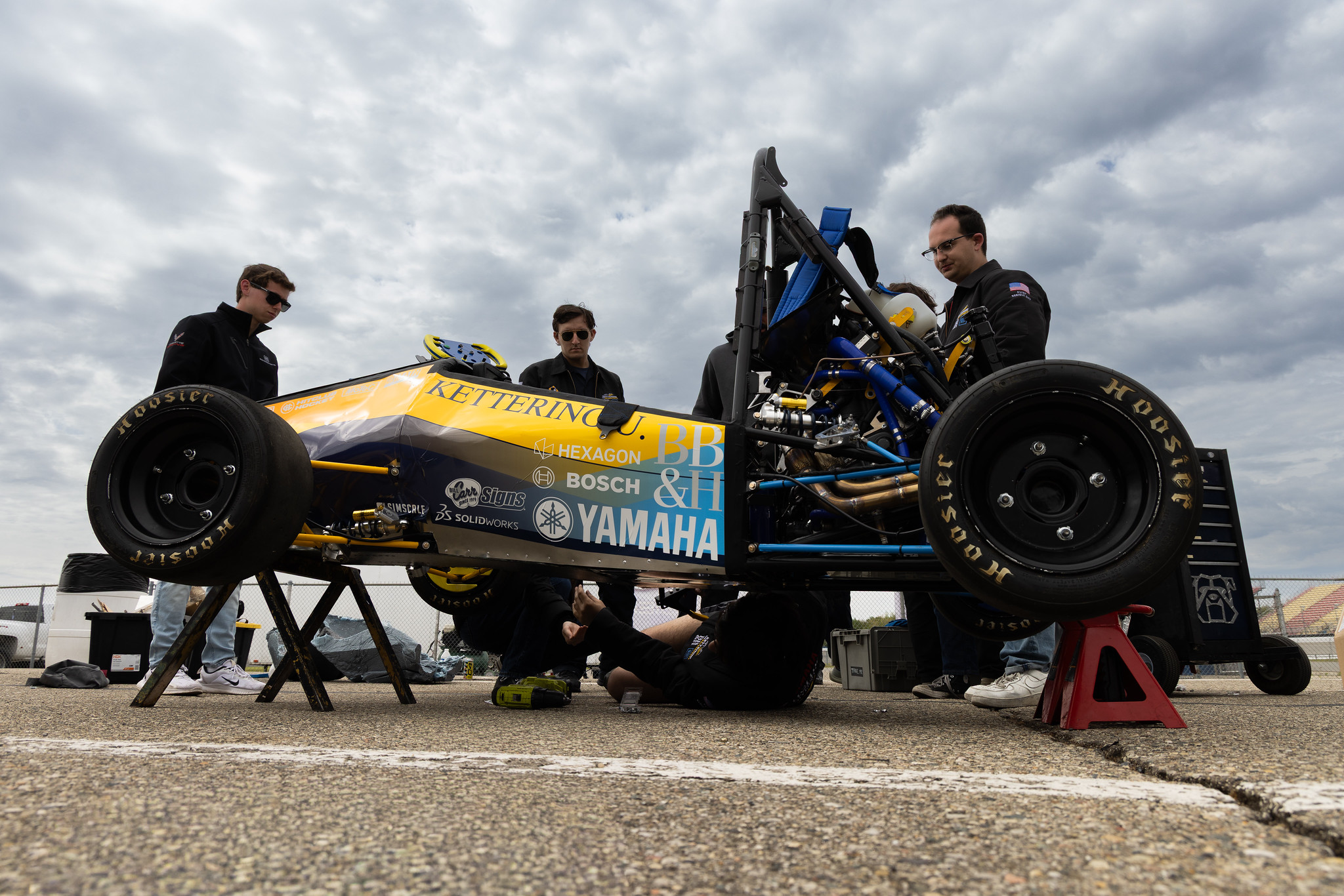
Today, at 30, Ordoobadi is studying mechanical engineering at Kettering, building race engines and designing aerodynamic systems for the Formula SAE team.
“Kettering is absolutely the right fit for me,” Ordoobadi said. “I’m getting hands-on experience working in the motorsports industry at my Co-op while getting all the foundational knowledge with my mechanical engineering degree.”
Ordoobadi grew up in Washington, D.C., balancing academics and athletics at DeMatha Catholic High School. After two years of junior hockey and four years as a power forward at Neumann University, he turned professional, signing with the Maine Mariners of the ECHL, a key developmental league for the AHL and NHL. He later helped lead the Florida Everblades to a league championship, hoisting the Kelly Cup, the ECHL’s top prize.
“Playing on a pro hockey team was always my dream,” he said. “Having lived that dream, I realized that I want to be part of a successful team for the rest of my life. I knew I couldn't play hockey at 55, but I could be an engineer at 55.”
Within weeks of arriving at Kettering, Ordoobadi had secured a placement at Ilmor Engineering, a race engine company based in Plymouth, Michigan, that supplies NASCAR and IndyCar teams. Working on engines for the ARCA and NASCAR Truck Series, he got his first taste of turning classroom theory into on-track reality. His next Co-op rotation will see him step into IndyCar’s hybrid era, gaining valuable trackside experience with cutting-edge technology.
"I was very fortunate to get a Co-op in exactly what I want to pursue as a career," Ordoobadi said. "Motorsports can be a really tough industry to break into. But thanks to Kettering, I started working in it from day one."
In the classroom, Ordoobadi tackled new challenges head-on, including learning MATLAB, a programming language essential for numerical computing, modeling, and data analysis.
“I had no experience with coding,” he said. “But through that class, I was able to write code that helped with the design of our new anti-roll bar for the Formula SAE car and analyze our tire data. Being able to learn something in class and then immediately apply it was really gratifying.”
As soon as he was on campus, Ordoobadi dove into Kettering’s Formula SAE team, leading the aerodynamics subsystem, designing wings, diffusers, and bodywork to push the car’s performance to the edge.
“Getting involved in the Formula SAE team has been an awesome experience, taking what I’ve learned from my Co-op and applying it to a project where the stakes feel real,” he said, “We're looking at the broad picture of performance and thinking about the car as a whole. To me, it is really exciting.”
Despite these early successes, Ordoobadi’s transition from professional athlete to full-time student wasn’t seamless.
“Adjusting back to student life was the biggest challenge,” he says. “But Kettering makes that transition as easy as it can be. The way the terms are structured — three months of classes, three months of work — fits my life perfectly. That back-and-forth rhythm feels natural for me, and it’s a lot less daunting than spending six straight months in classes.”
Looking ahead, Ordoobadi has a clear goal.
“After graduating, I hope to be working trackside for a motorsports team,” he said. “Being part of a team was everything to me in hockey, and it’s the same now. Whether it’s in the shop, on the track, or in the classroom, I want to contribute to a team’s success.”